LGBTQ+ History Month: Orlando Callegaro on reinforcing a sense of identity and belonging through documentation
- Written byJoe O'Brien
- Published date 15 February 2023
Share story
As part of LGBTQ+ History Month, we've been speaking to UAL graduates who fit into this year's theme of 'Behind the Lens'. We caught up with Orlando Callegaro, MA Photography at CSM graduate and frequent collaborator with UAL as an Arts Temp.
You wear many hats as a visual artist, photographer, videographer and social media content creator. Can you talk to us a bit about how UAL helped shape your professional journey?
UAL has been in my life for over six years now nurturing me both as an artist and as a professional. My journey with UAL started at CSM when I was studying MA Photography. It was quite shocking, coming from Italy and its theory-based educational system, to land at a university where practice and experimentation are at the core of the learning experience. The course really pushed me out of my comfort zone as a Fine Art photographer and I had to rethink my idea of photography and to redefine my art practice which has expanded to include live performances and video installations.
During my MA, among other small jobs, I also started working as a shelver in the CSM library. This might sound boring, but for me it gave me the chance to bump into and browse many interesting books. Before pursuing a career as a visual artist/creative, I had been working in the banking sector for many years. So, all those books really helped expanding my knowledge of art and the creative sector. Through this job I became acquainted with Arts Temps and, since I was already doing some photography and filming jobs, I started searching for jobs related to my background. During the pandemic I became assistant technician at CSM Loan Store, which opened a whole new field of sound recording. After lockdown eased, I started taking up jobs as a videographer when there was a need to record interviews. Since then, I’ve had the opportunity to work with many different teams across UAL, gaining more experience as a photographer and growing as a social media content creator. Now I’ve got to a point where I’m thinking, why not try to move from social media content to the film industry?
The theme for LGBTQ+ History Month 2023 is ‘Behind the Lens’, allowing us to focus on a real creative aspect of LGBTQ+ history. In your opinion, how has creativity contributed to LGBTQ+ movements in history?
This is a very complex question, and I would rather focus on photography and filmmaking. Both have had and, I believe, still have a fundamental role in giving queer people the representation they need in creating their own visual history. Representation and documentation are extremely important to create and reinforce a sense of identity and belonging. These can create movements that push cultural change. In this respect, I’m thinking of works made by queer artists with and for their community. From the more famous works of Mapplethorpe (especially his censored S/M series), Sunil Gupta, Catherine Opie’s series Being and Having or Zanele Muholi’s Faces and Phases portrait series, to the lesser known works of Del La Grace Volcano.
Del La Grace, an intersex person, documented the early San Francisco drag king scene in the '90s, publishing the first book on the topic with queer-study scholar Jack Halberstam. Del had a relevant role in documenting the post-punk dyke scene of the '80s and '90s in London. A subgroup of LGBTQI+ young women involved in political movements of the period 1983 - 1991, including Greenham Common, South London Women’s Hospital Occupation, anti-censorship, sex-positive feminism, sex workers rights, anti Section 28, ACT-UP and the Poll Tax Riots. As a movement they were also heavily involved in art and culture, creating bands, art, club nights, zines and festivals. Del’s work and pictures, circulating at the time only in queer publications, have become iconic of a specific identity and are now featured in major exhibitions and museums. The role of the rebel dykes in the LGBTQ+ '80s movement has recently come to prominence through the documentary Rebel Dykes. Directed by Harri Shanahan and Siân A. Williams, two young rebel dykes, and produced by Siobhan Fahey, one of the '80s rebel dykes, the documentary is an excellent example of how creativity has contributed and is contributing to the fight for inclusivity in society.
Documentation and representation are still an essential part of the LGBTQI+ movements. Transgender writer and filmmaker Campbell X is doing incredible work, both with their films and activism, for the visibility and recognition of Black queers. While filmmaker Sweatmother has just launched the Otherness Archive, a digital archive that aims at preserving and making accessible a wide variety of queer independent/small budget/DIY films with a specific focus on trans masculinity.
It’s not uncommon for the talent ‘behind the lens’ to be overlooked for those in front of the camera. Do you feel that there’s more visibility for LGBTQ+ creatives than when you first started out?
To answer to this question I’d like to mention the recognition recently gained by artists Charlotte Prodger, Sin Wai Kin and Heather Cassils. The first was the 2018 recipient of the Turner Prize with the film Bridgit, revolving around her queer identity. Non-binary artist Sin was a Turner Prize Nominee in 2022 for their work which uses drag to create characters deconstructing and reconstructing social narratives about gender, bodies, beauty and identities. The 2022 V&A Exhibition Fashioning Masculinities featured a video installation by Heather Cassils in which they use the warmth of their own body to dissolve an idealised ice torso, reflecting on how trans bodies are causing the dissolution of the conventional notion of masculinity.
The art world has certainly come a long way and is now more inclusive. Queer artists of all levels can find financial programmes supporting their work. However, this is true with different degrees in Western Europe. For example, in Italy, the country I come from, attention for diversity has not yet become a common policy in art institutions, so it’s still hard for queer artists to find publicly funded support initiatives.

You recently exhibited at Ugly Duck, can you talk us through your installation and share some imagery?
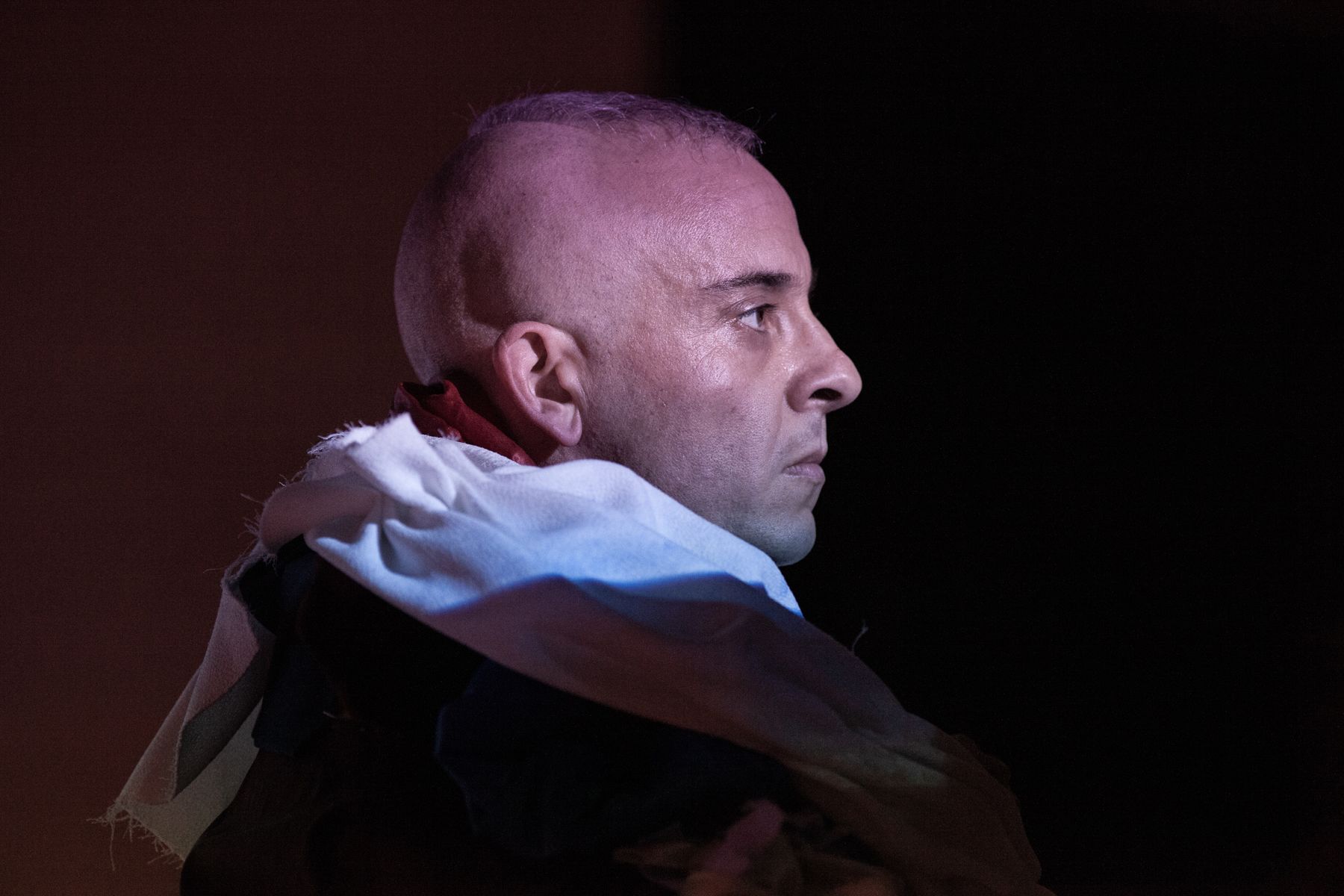
In November 2022 I was part of @Disturbance, a programme promoted by Ugly Duck to champion LGBTQIA+ performance, video and digital artists. I exhibited my work-in-progress The Plastic Drag, an experimental visual work at the crossroads of video-art and documentary film-making investigating the art of drag performed by a new wave of trans and non-binary drag performers.
The video installation presents drag artists Karen Fisch and Jorge Maldonado engaging in a monologue/dialogue with their drag personas, King Frankie Sinatra and Veronica Maldonado respectively. Intertwined with their words a visual landscape offers a window onto their iconic inspirations.
The work specifically intends to investigate how images are involved in the creation of a drag persona and how drag can be employed to critically address not only societal norms around gender but also issues related to racism, misogyny, homophobia, transphobia, mental health, body positivity and ableism.
As a photographer and filmmaker, I've documented the London drag scene since 2017 and that made me appreciate the importance of drag performers for the queer community, as they give expression and image to all the new gender identities that are emerging in recent years. What also attracted me to these performers is that their art is political, not only because they defy gender norms, but also because they engage with issues such as racism, decolonisation, mental health, ableism and obviously the patriarchy.
The Plastic Drag aims at celebrating these performers, creating a series of portraits that give audiences an insight into their art.

Do you have any historical figures from the LGBTQ+ community, or those making history right now, that inspire you and your work?
I don’t have just one specific figure. I think I’m inspired by many different people in the queer and trans community I’m part of.
I have a lot of admiration for everyone who is fostering creative initiatives for the trans and non-binary community to come together and celebrate their uniqueness in safe spaces.
- Ingo Cando and Lysander Dove, respectively founder and artistic director, of Bar Wotever, the longest-running regular queer cabaret night in London (and probably in the world), which in 2023 celebrates its 18th birthday. Bar Wotever has been and still is a place for queer artists to experiment and for the young queer community to have a place to meet and feel free to express themselves.
- Adam All and King Frankie Sinatra whose shows BoiBox and Kings of Clubs have nurtured and supported the growth of drag kings.
- Prinx Silver, Jamie Fuxx, Lori Del Bianco and Kane who are producing club nights for T-boys and are inspiring new generations of trans masc people to feel valid in their pursuit of a soft masculinity.
- Deen Atger the Artistic Director of the Ugly Duck which for over 10 years has been giving queer artists space and support to develop and exhibit their work.
- Artist Joseph Morgan Shoefield, who since 2017 has activated spaces and projects for queer performance artists to showcase their experimental works.
Connecting with these people and being part of the community is what ultimately fuels my motivation in doing art work that speaks for the queer and trans community.
As a freelance photographer and videographer, you’ve had the opportunity to work on a real range of projects. Can you share a particular favourite with us, and is there anything you haven’t yet had the opportunity to do that you’d like to?
My favourite project I’ve worked on is also the one that I would like to have the opportunity to do.
In 2022 I was supposed to work on Grayson Robes Competition video. It was a project that I started but unfortunately had to cancel for personal reasons. Even though I couldn’t work on it, I still had the chance to meet Grayson in his studio, as I filmed his speech for the graduation ceremonies. I was expecting a bit of an intimidating personality, so I was surprised to discover that he is really an easy-going person. It would have been a great opportunity to film him during the selection process of the winning design and work on the final video of the competition. It was a great privilege to know him in person. He is inspiring not only as an artist, but also because he has been questioning masculinity as a white straight man and supported the launch of the Museum of Transology.
Outside UAL my favourite personal project is the long-term video and photo documentation project of queer events such as:
- Queer cabaret nights like Bar Wotever and Kings of Clubs
- London Queer Fashion Show
- The first London Trans Fashion Show
- The queer and feminist exhibition-cum-performance-club-night Deep Trash.
A work that I’ve been doing since 2017 and that will become part of the Bishopsgate Institute Archive as a special collection, is the Orlando Myxx Archive. There will be a launch event in June 2023.
As for the opportunity that I’d really like to have, that is to see my application for Arts Council funding being approved, allowing me to develop my Plastic Drag project into a series.