LGBTQ+ History Month: Tim Boddy on the importance of documenting queer spaces

- Written byAnnika Loebig
- Published date 01 February 2023
Share story
With the theme for this year’s LGBTQ+ History Month being ‘Behind the Lens’, there’s no better time to spotlight Tim Boddy: An alum from MA Photojournalism & Documentary Photography at London College of Communication, Tim has been documenting queer spaces and those keeping them alive since producing his final major project ‘Fabulous Ones’, an archival project meant to counteract the threat of erasure of marginalised communities in traditional archives.
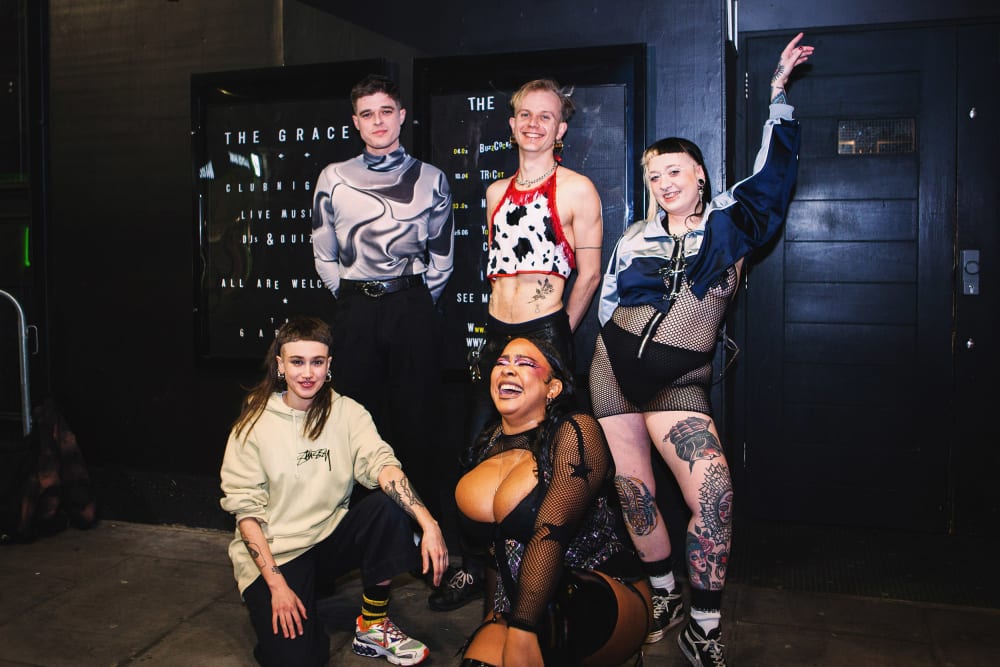
With support from UAL’s Mead Fellowship, he’s been building on this work through what eventually became the multidisciplinary project ‘Queer Spaces: Behind the Scene’, a podcast and photography project mapping queer spaces in London and considering what makes them what they are and who is permitted to define them.
We recently caught up with Tim to talk about his work, some of his most memorable photography sessions and queer figures throughout LGBTQ+ history that have inspired him so far.
Hi Tim! You started looking at queer spaces during your Final Major Project (FMP), a photographic archive called ‘Fabulous Ones’. How has your interest in documenting queer spaces evolved since then?
[My FMP] helped me realise that this is a really fertile area and something I’m very passionate about, because I think queer spaces are so vital to the mental health of the LGBTQ+ community. There are so many stories to tell and it's constantly evolving and changing.
Just after University, I realised I had collected a lot of interviews with people that were running queer spaces, just on my laptop and various recording devices. When I was listening through them, I thought it would be so good for these to have some kind of public life. Rather than releasing these very hastily recorded things with poor sound quality, I thought, ‘How great would it be to do a podcast and help celebrate people in the community?’
It also helps to cut out my opinions in a way. Obviously, it's got my fingerprints on the project, but it's less about my point of view and what I have to say, and more about queer people telling their own stories and taking ownership over that. The project has got photography as well, so it's nice bridging this visual photographic world and having something that you can really get into and explore like a podcast.
Why do you think it's important to document both queer spaces, as well as the people behind them?
I have asked myself that quite a bit as with the ‘Queer Spaces’ project, even though it's about spaces, I am essentially spotlighting the people that run them. So, it's almost like a celebration, if you like, an ode to those that are putting a lot of hard work into creating these much-needed events, nights out, just creating community essentially. But I think it's very hard to separate people and spaces as it is so interlinked.
I have had some interesting conversations on the podcast about taking over straight spaces or heteronormative spaces, whatever you want to call them. If you just have a bunch of queer people in the room, in any room, does that make it a queer space? I don't have the answer to that question. But I think it's a really fun question to ask because it feels like yes, sometimes it does.
On the podcast, someone told me they went to a Charlie XCX show in Lafayette and most of the people there were overtly queer. They were there with a lot of their queer friends, they bumped into people that they knew from their own queer parties that they run. It felt like this is just a big happy queer party without being in a queer space, but it kind of temporarily becomes a queer space, which is interesting. There are no binaries in this. I guess some spaces are queerer than others, but apart from that, I don't think you can necessarily say something is 100% what it is, because it's such a slippery word.
Considering that your project bridges the gaps between activism and art, what role would you say creativity plays in bringing about positive change for LGBTQ+ people?
There's a strong link between activism, politics and creativity and art. On the other hand, this raises bigger questions about what art is - which I'm not so interested in - but I think art can be political just by existing. Art can be an act of protest, depending on who you are, and where you are in the world, even in this country. There's a lot more overlap that I see these days between activism and art.
I guess at heart I am sort of an activist and being an artist is almost secondary for me. My work has to have a point. I just feel like I need to represent the LGBTQ+ community in a small way and showcase other people's work and voices and talent and other people that bring communities together.
Looking at your work online, I noticed you’ve photographed some iconic figures in the LGBTQ+ community – how were you able to reach out to them and include them in your work?
When I photographed Peter Tatchell, he was part of the Queer London book, which was written by Alim Kheraj. He’s a great writer and very knowledgeable on queer spaces and just everything queer in pop culture as well. I was commissioned by Alim to take photographs of people as they were going to include around 12 interviews in this book with key LGBTQ+ figures that have all lived in London; some more historical figures and others more contemporary ones. It's a real mix, from the early days of Peter Tatchell, because he was around in the 70s, getting arrested and just being amazing, and very contemporary ones like Olly Alexander and Lady Phyll, who runs UK Black Pride.
I suppose I played a small part in the decision-making process to make sure the book had a good range of voices, in terms of diversity, backgrounds and age, which is really hard, because there's so many interesting and amazing people, but you don’t want it to be too weighted towards current day trends or make it too cisgendered or male.
Because I was commissioned by a publisher, this helped me get in touch with all these amazing people. It's quite surreal looking back on it as well, as I photographed most of them between 2 lockdowns. In 2020, I hadn’t talked to many human beings and the few people that I did hang out with and talk to are these incredibly important queer people. It was remarkable. It was a great project to be part of and I'm glad Alim asked me.
Are there any other historical figures - that either made history or are making history right now - that really inspire you and your work?
Oh gosh, so many! I guess the people that I spotlight in the Queer Spaces podcast: these are people that I genuine look up to and think are doing very important and amazing things.
I should also absolutely mention Derek Jarman, who I'm a huge fan of. His inspiration was like a golden thread that ran through a lot of my work, particularly at University.
His book ‘Modern Nature’ is one of my favourite pieces of work by him:
He fostered this garden in Kent, Dungeness by this huge nuclear power plant; this dystopian background visually in front of him, while also living through Thatcher’s Britain at that time, which was a horrible place. But the book itself is full of so much humour and hope, alongside cataclysmic loss. The fact that he curated this garden in one of the most hostile environments in the UK as his act of resistance was just really beautiful.
It was towards the later years of his life, and he was HIV positive, so there’s always this melancholic tinge to the whole thing. He produced an incredible body of work, while remaining hilarious at the same time. So yeah, Derek Jarman is one of my people.

Is there anything that you haven't done that you would really like to do in the future?
That's such a tough question. Honestly, I'm not very goal orientated. Maybe this isn't a very good answer, or one that people want to hear. But there's some small things: I want to make sure that ‘Queer Spaces’ has a future life, which won't be easy, necessarily, because it was very intensive work for a few months, and I need some kind of funding or support from others in some capacity. But I'd love to continue that.
I guess I would like to continue making work within the LGBTQ+ community. If it's not ‘Queer Spaces’, hopefully something else. I'm not always going to be able to do that; I think there'll be pockets of time where it's just impossible, but I hope that in some capacity, I can keep doing that for years and years to come. I hope so anyway.